
Introduction: Why Coaches Define Modern Football
In the 21st century, the role of the football coach has evolved beyond tactics and training. Modern football demands visionaries, not just managers—leaders who can shape players’ careers, evolve entire teams, and influence the global game.
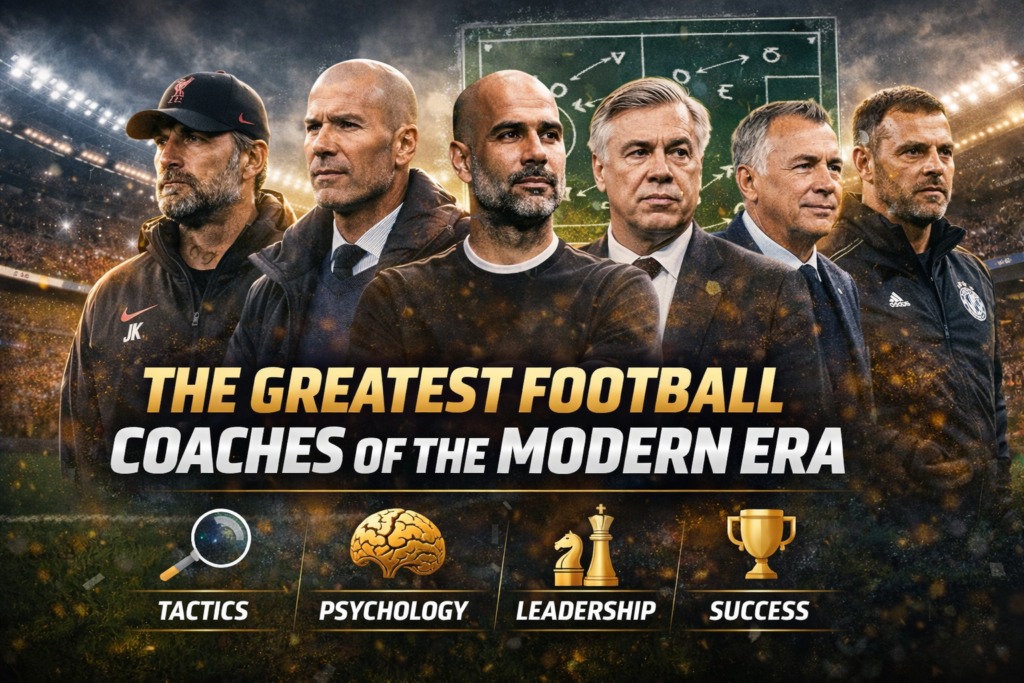
The best coaches are no longer only about winning matches; they create legends, dictate tactical trends, and master psychological management. This article explores the greatest football coaches of the modern era, their philosophies, successes, failures, and the lessons they leave behind.
1. Pep Guardiola: The Architect of Possession Football
Philosophy:
- Total Football revival with a modern twist
- Positional play (Juego de Posición)
- High pressing and possession dominance
Impact on Players:
- Transformed defenders into midfield playmakers (e.g., Philipp Lahm, Sergio Busquets)
- Elevated attackers’ tactical intelligence
Key Achievements:
- Barcelona treble 2008–2012
- Multiple Premier League titles with Manchester City
- UEFA Champions League final appearances with City
Human Touch:
Guardiola’s leadership is not authoritarian; he inspires players to think, innovate, and enjoy football while maintaining discipline.
2. Jürgen Klopp: The Master of Gegenpressing
Philosophy:
- High-intensity pressing
- Quick transitions and verticality
- Emotional connection with fans and players
Impact on Players:
- Turned Roberto Firmino into a multifunctional forward
- Boosted Salah and Mane to world-class status
- Developed young talents like Trent Alexander-Arnold
Key Achievements:
- Champions League 2019
- Premier League 2020 after 30 years
- Consistent title contention across Europe
Human Touch:
Klopp’s charisma creates team culture, where players feel emotionally invested. His motivational approach often converts underperformers into leaders.
3. Zinedine Zidane: The Elegant Manager
Philosophy:
- Simplifying football for elite players
- Man-management above tactics
- Focus on peak performance during decisive moments
Impact on Players:
- Balanced egos of star-studded Real Madrid squad
- Enhanced tactical discipline without reducing creativity
- Managed Ronaldo, Bale, Benzema, Modrić to peak synergy
Key Achievements:
- 3 consecutive UEFA Champions League titles
- La Liga 2016–2017
- FIFA Club World Cup successes
Human Touch:
Zidane excels at reading players’ minds, calming pressure, and maintaining harmony—something statistics cannot measure.
4. Hansi Flick: Tactical Genius Behind Bayern’s Dominance
Philosophy:
- Dynamic positional rotations
- High pressing with rapid counter-attacks
- Exploit transitional moments
Impact on Players:
- Turned Müller into a tactical all-rounder
- Optimized Lewandowski’s goal-scoring efficiency
Key Achievements:
- Bundesliga and Champions League treble 2019–2020
- FIFA Best Coach award 2020
Human Touch:
Flick’s coaching style emphasizes trust and simplicity, allowing players to flourish naturally without overcomplication.
5. Sir Alex Ferguson: The Legendary Longevity
Philosophy:
- Man-management above tactics
- Youth development focus
- Strategic in-game adaptation
Impact on Players:
- Mentored Ryan Giggs, Paul Scholes, Cristiano Ronaldo
- Maintained competitive squad over decades
- Adapted tactics over eras without losing identity
Key Achievements:
- 13 Premier League titles
- 2 UEFA Champions League victories
- Countless domestic trophies
Human Touch:
Ferguson’s charisma and discipline combined fear with respect, pushing players to achieve more than they imagined.
6. Carlo Ancelotti: The Calm Strategist
Philosophy:
- Flexibility in formation and tactics
- Strong player-coach relationships
- Emphasis on mental strength in finals
Impact on Players:
- Helped Zidane, Ronaldo, and Kaká reach peak performance
- Developed multi-role midfielders like Modrić and Kroos
Key Achievements:
- Multiple Champions League wins with Milan & Madrid
- Domestic titles across Italy, England, France, and Germany
Human Touch:
Ancelotti’s calmness reduces pressure, letting stars perform naturally while maintaining focus and discipline.
7. Tactical Comparisons: How Styles Shape Modern Football
| Coach | Philosophy | Pressing | Possession | Adaptability | Human Touch |
|---|---|---|---|---|---|
| Guardiola | Positional play | Medium | Very High | High | Inspirational |
| Klopp | Gegenpressing | Very High | Medium | High | Emotional |
| Zidane | Simplicity & man-management | Medium | High | Medium | Psychological |
| Flick | Dynamic transitions | High | High | High | Trust-based |
| Ferguson | Long-term man-management | Medium | Medium | Very High | Charismatic |
| Ancelotti | Flexibility | Medium | Medium | Very High | Calm & supportive |
8. The Human Factor: Beyond Tactics
Great coaches are not defined only by trophies. Their influence spans:
- Shaping careers
- Mental resilience in players
- Cultural impact in clubs and countries
A tactical genius without emotional intelligence rarely achieves greatness.
9. Modern Coaching Trends
- Data-Driven Decisions: Player tracking and analytics
- Rotational Tactics: Midfielders and forwards with multiple roles
- Youth Integration: Developing adaptable stars early
- Psychological Coaching: Managing pressure and public scrutiny
10. Conclusion: Coaches Are the Architects of Modern Legends
Football players make headlines, but coaches craft the environment where greatness is possible.
The modern football legend is as much a product of strategic thinking and man-management as of talent and work ethic.
Adaptable, intelligent, and human-focused coaches create dynasties, innovations, and unforgettable moments. The legacy of Guardiola, Klopp, Zidane, Ferguson, Ancelotti, and Flick proves that tactical genius combined with emotional intelligence is the ultimate formula for success.