

Introduction
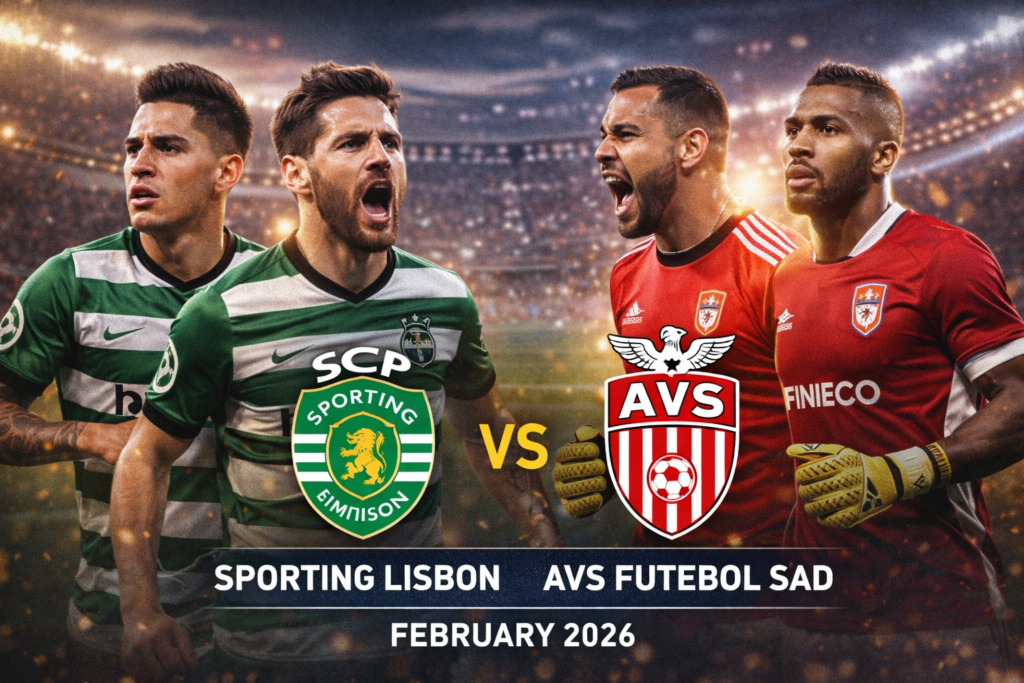
The clash between Sporting Lisbon and AVS Futebol SAD, played in early February 2026, attracted significant attention from Portuguese football followers. While the match looked straightforward on paper, football rarely follows scripts. This encounter brought together a traditional powerhouse with a clear identity and an ambitious side aiming to challenge the hierarchy. Beyond the scoreline, the match reflected deeper themes of tactical evolution, psychological pressure, and the contrast between experience and belief.
Match Context and Importance
For Sporting Lisbon, the game was part of a demanding period in the season, where squad rotation, mental focus, and tactical discipline were essential. Competing across multiple domestic competitions, Sporting viewed this match as a necessary step toward silverware and a test of their consistency.
AVS, meanwhile, entered the fixture with nothing to lose. Matches like this represent defining moments for smaller clubs—opportunities to gain visibility, confidence, and respect. Facing a giant away from home placed AVS under intense pressure, but also offered the freedom to play with courage and ambition.
Team News and Squad Updates
Sporting Lisbon
Sporting approached the match with a largely stable squad. The coaching staff emphasized balance between defensive security and attacking fluidity. Several key players were confirmed fit, allowing Sporting to maintain continuity rather than experiment.
The defensive unit was built to support possession-based football, while the midfield remained the engine of creativity and control. In attack, Sporting relied on movement, pressing, and intelligent positioning rather than individual brilliance alone.
AVS Futebol SAD
AVS faced limitations in squad depth but compensated with collective organization. The team focused on physical readiness and mental resilience, knowing that sustained pressure was inevitable. Their preparation centered on defensive structure, discipline, and maximizing transitional moments.
Expected Lineups
Sporting Lisbon (4-2-3-1):
Goalkeeper; Back four with attacking full-backs; Double pivot in midfield; Three attacking midfielders supporting a central striker.
AVS Futebol SAD (4-4-2 / 4-2-3-1):
Compact defensive line; Narrow midfield; Quick forwards positioned to exploit counter-attacks.
These formations highlighted Sporting’s intention to dominate possession, while AVS prioritized defensive compactness.
Tactical Analysis
Sporting Lisbon controlled the tempo from the opening minutes. Their pressing structure aimed to win the ball high and prevent AVS from building attacks calmly. The use of wide areas stretched AVS defensively, creating passing lanes through the middle.
AVS responded with a deep defensive block, forcing Sporting to circulate the ball patiently. When possession was regained, AVS attempted quick vertical passes, hoping to catch Sporting’s defense during transitions.
The key tactical battle occurred in midfield. Sporting’s numerical superiority allowed them to recycle possession and dictate rhythm, while AVS struggled to maintain sustained spells on the ball.
Psychological and Human Dimension
Matches like this are as much mental as they are physical. Sporting players carried the weight of expectation, knowing that anything short of control and victory would be considered failure. This pressure demanded composure and discipline.
For AVS, motivation came from pride and ambition. Players approached the match with determination, understanding that strong performance—even without victory—could define careers and raise the club’s profile. This emotional contrast shaped the intensity of the contest.
Key Moments and Match Flow
As the match progressed, Sporting’s territorial dominance became clearer. AVS defended bravely, but fatigue gradually reduced their ability to close spaces. Sporting’s patience eventually paid off, as movement between the lines created decisive opportunities.
Despite moments of resistance, AVS found it increasingly difficult to escape pressure. Sporting’s ability to manage the game without losing structure highlighted their maturity and tactical intelligence.
Post-Match Evaluation
From Sporting’s perspective, the match reinforced their identity: controlled possession, tactical discipline, and collective responsibility. The performance demonstrated why they remain one of Portugal’s most consistent teams.
AVS, despite the result, earned respect through organization and effort. Their experience in such a demanding environment will be valuable for future domestic campaigns.
Conclusion
The Sporting Lisbon vs AVS match in February 2026 was more than a routine fixture. It was a demonstration of football hierarchy, preparation, and psychology. Sporting confirmed their status through control and patience, while AVS showed resilience and ambition. Matches like these remind us that football’s beauty lies not only in goals, but in stories of contrast, effort, and belief.