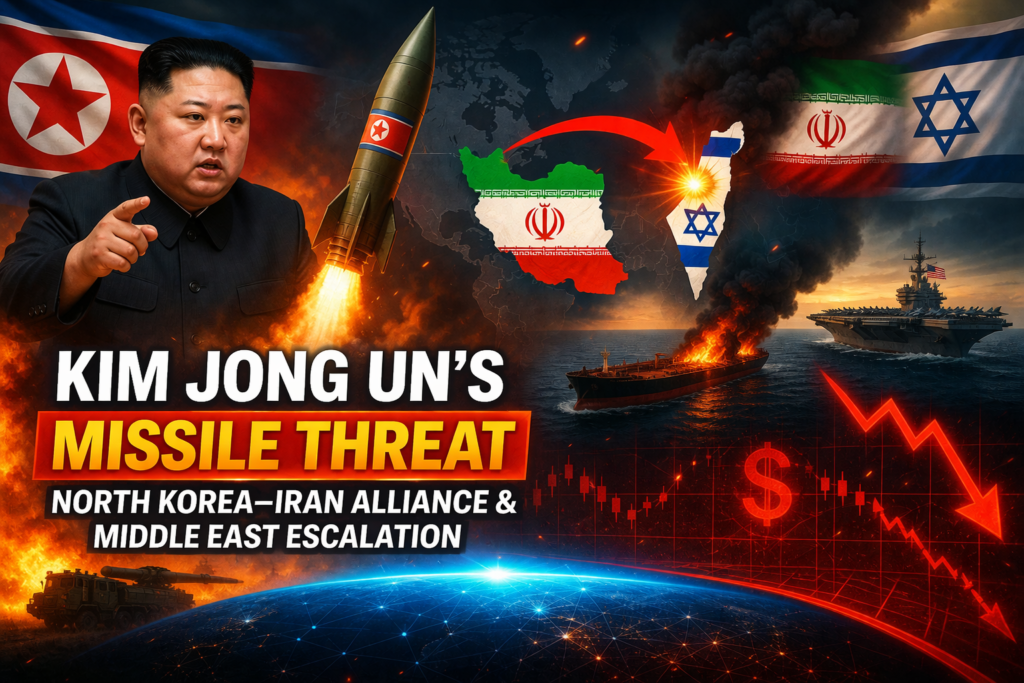

An in-depth analysis of the North Korea–Iran alliance, Kim Jong Un missile threat, and rising Middle East escalation shaping global security risks.
Introduction
Could a single statement from Pyongyang truly shift the balance of power in the Middle East?
Recent rhetoric attributed to Kim Jong Un has reignited global anxiety. Reports claiming that North Korea may supply missiles to Iran—and that “one missile is enough to remove Israel”—have intensified fears of a broader Middle East escalation. Whether literal, strategic messaging, or psychological warfare, such declarations reverberate far beyond East Asia.
In this comprehensive analysis, you’ll discover:
- The strategic depth of the North Korea–Iran alliance
- The credibility and implications of the Kim Jong Un missile threat
- How this dynamic influences Middle East escalation
- The role of major powers including the United States, China, and Russia
- What it means for energy markets, regional security, and global stability
Let’s break this down with clarity and precision.
The Strategic Context: Understanding the North Korea–Iran Alliance
Historical Foundations of the North Korea–Iran Alliance
The North Korea–Iran alliance is not new. It dates back to the 1980s during the Iran-Iraq War. At the time, Tehran relied heavily on Pyongyang for:
- Scud missile technology
- Weapons procurement channels
- Military training
Over decades, cooperation reportedly evolved from basic arms transfers to more sophisticated ballistic missile development.
While neither government openly advertises the depth of cooperation, Western intelligence agencies have long suspected technical exchanges in:
- Short-range ballistic missiles (SRBMs)
- Medium-range ballistic missiles (MRBMs)
- Missile fuel technologies
- Possibly guidance systems
Why This Alliance Matters Now
The geopolitical environment has shifted dramatically:
- Heightened tension between Iran and Israel
- Increased US-led coalition activity in the region
- Russia’s confrontation with Western powers
- China’s growing but calculated influence
In this climate, even rhetorical alignment amplifies risk perception.
Kim Jong Un Missile Threat: Strategic Bluff or Real Capability?
Assessing the Credibility
North Korea possesses:
- Intercontinental ballistic missiles (ICBMs)
- Solid-fuel missile systems
- Advanced mobile launch platforms
However, supplying missiles to Iran is a complex matter involving:
- Logistics: Transfer routes would require covert maritime or air channels.
- Sanctions Monitoring: Both nations face heavy international surveillance.
- Technical Integration: Compatibility with Iranian launch systems.
The phrase “one missile is enough” should be interpreted as deterrent rhetoric rather than operational planning.
Strategic Messaging and Psychological Warfare
Such statements serve several purposes:
- Signal defiance toward Western alliances
- Strengthen diplomatic leverage
- Reinforce deterrence posture
- Encourage multi-front pressure on adversaries
In strategic communications theory, this fits into coercive signaling—raising stakes without necessarily crossing operational thresholds.
Middle East Escalation: A Multi-Layered Risk
The Middle East escalation is not occurring in isolation. It intersects with global fault lines.
1. Israel’s Security Calculus
Israel maintains:
- Advanced missile defense systems (e.g., layered interception architecture)
- Strategic ambiguity regarding nuclear deterrence
- Close intelligence coordination with Washington
Any credible missile transfer would dramatically alter Israel’s preemptive defense calculus.
2. Energy Markets and Global Economics
Escalation affects:
| Factor | Impact |
|---|---|
| Oil Prices | Volatility due to supply disruption fears |
| European Gas | Price surges amid instability |
| Shipping Insurance | Premium increases in conflict zones |
| Emerging Markets | Currency pressure |
The Strait of Hormuz remains a critical chokepoint. Even perceived threats can spike oil futures within hours.
3. Great Power Alignment
Emerging alignment concerns include:
- Russia’s diplomatic backing of Iran
- China’s strategic balancing act
- North Korea’s confrontational posture
While not a formal alliance bloc, their overlapping interests complicate Western containment strategies.
Could This Become a Broader Conflict?
Scenario Analysis
Let’s consider plausible trajectories:
Scenario 1: Rhetorical Escalation Only
- No missile transfers occur
- Statements serve domestic propaganda
- Tensions cool after signaling phase
Probability: Moderate to High
Scenario 2: Limited Proxy Escalation
- Indirect arms transfers
- Increased proxy engagements
- Cyber operations intensify
Probability: Moderate
Scenario 3: Direct Regional Confrontation
- Israeli preemptive strike
- Iranian retaliation
- US involvement expands
Probability: Lower—but with severe consequences
As someone following geopolitical risk trends, you’ve likely noticed how quickly rhetoric can transition into action under pressure.
The Energy and Financial Dimension
Energy instability amplifies geopolitical shocks.
If conflict disrupts:
- Iranian oil exports
- Gulf shipping lanes
- Regional infrastructure
We could see:
- Brent crude surpassing critical thresholds
- Inflation resurgence in Europe
- Central banks delaying rate adjustments
Markets react not just to events—but to perceived probabilities.
International Law and Sanctions Implications
Missile transfers would likely violate:
- UN sanctions frameworks
- Missile Technology Control Regime (MTCR) principles
- Bilateral non-proliferation commitments
New sanctions could target:
- Shipping firms
- Financial intermediaries
- Defense manufacturers
This would deepen global economic fragmentation.
The Human Dimension Behind the Headlines
It’s easy to view this purely as strategic chess. But escalation impacts:
- Civilians living under missile threat
- Global consumers facing rising energy costs
- Investors managing portfolio volatility
- Families in militarized regions
Imagine waking up in a city under alert sirens. Strategic doctrine suddenly becomes personal reality.
This is why restraint and diplomatic backchannels matter—even when rhetoric is loud.
Strategic Takeaways
Here’s what you should retain:
- The North Korea–Iran alliance has historical roots and technical precedent.
- The Kim Jong Un missile threat functions primarily as strategic signaling.
- The broader Middle East escalation reflects intersecting regional and global rivalries.
- Energy markets and global finance remain highly sensitive to perception shifts.
- Great power alignment increases systemic risk—but does not guarantee direct confrontation.
Conclusion
The evolving dynamics surrounding the North Korea–Iran alliance and Kim Jong Un missile threat represent more than isolated rhetoric. They are embedded within a fragile geopolitical ecosystem already strained by competing alliances, economic pressures, and military posturing.
While immediate large-scale war is not inevitable, the margin for miscalculation is narrowing.
In geopolitics, perception shapes reaction—and reaction shapes reality.
Maintaining analytical clarity, separating rhetoric from capability, and monitoring tangible indicators will be critical in the months ahead.
Call to Action
What’s your assessment—strategic bluff or emerging alliance shift? Share your perspective in the comments below and join the discussion.
If you found this analysis valuable, consider sharing it with colleagues who follow global security and energy markets.