
Executive Overview
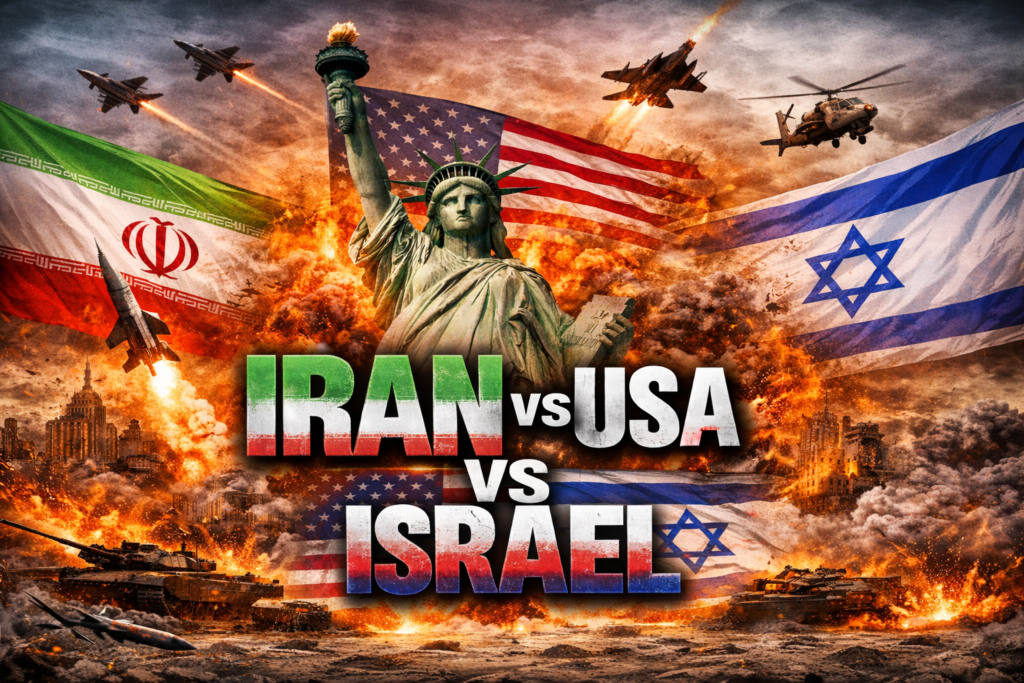
The geopolitical confrontation involving Iran, the United States, and Israel has evolved beyond a background rivalry or manageable proxy conflict. It is now a multi-layered strategic confrontation, combining military posturing, economic warfare, cyber operations, intelligence campaigns, proxy militias, and ideological competition.
Recent events—particularly the joint military strikes by Washington and Tel Aviv in February 2026, which resulted in the martyrdom of Iran’s top political and military leadership—have escalated the confrontation from “managed conflict” to open confrontation, signaling a radical transformation of the region’s map.
This conflict is not a conventional war; it unfolds simultaneously across multiple fronts:
- On the ground: Syria, Iraq, Lebanon
- At sea: Persian Gulf, Eastern Mediterranean
- In airspace: drones and missiles
- Cyberspace: cyber warfare
- Financial markets: sanctions and economic measures
- International diplomacy
The danger lies not in an immediate full-scale war, but in gradual escalation, miscalculation, and the intertwining of regional crises, which could trigger an uncontrollable explosion.
Part I: Deep Historical Foundations – From Strategic Partnership to Existential Enmity
The Strategic Break: 1979 and After
The Iranian Revolution of 1979 fundamentally altered Middle Eastern geopolitics. The overthrow of the Shah—Washington’s key ally—was not only a regime change but an ideological revolution rejecting Western hegemony.
- The Islamic Republic adopted a narrative of supporting the oppressed (mostazafin) and resisting arrogance (estekbar).
- The United States became the “Great Satan” in Tehran’s perception.
- Israel, formerly a silent security partner under the Shah, was now perceived as an existential ideological threat.
- The slogan “Jerusalem is the axis of our Islamic unity” placed opposition to Israel and support for the Palestinian cause at the heart of Iran’s foreign policy.
The U.S. embassy hostage crisis entrenched distrust, and sanctions became a recurring tool. With U.S. invasions of Afghanistan and Iraq, Tehran gained unprecedented influence in Baghdad, further escalating tensions.
Israel’s Security Doctrine and Iranian Encirclement
Israel’s strategy is based on:
- Qualitative Military Superiority (QME)
- Preventing nuclear proliferation among adversaries
- Preemptive deterrence
Iran’s post-2003 expansion, especially in Syria, was seen as a strategic encirclement, aiming to create a land corridor from Tehran to the Mediterranean via Iraq, Syria, and Lebanon (Hezbollah).
For Israel, this is existential, as Iranian rhetoric includes calls for its eradication, framing the conflict as ideological survival rather than conventional rivalry.
Part II: The Nuclear File – The Core of Strategic Rivalry
From the JCPOA to Maximum Pressure
The 2015 Joint Comprehensive Plan of Action (JCPOA) limited Iran’s nuclear activities in exchange for sanctions relief.
- Supported by the P5+1 and Obama administration
- Strict limits on enrichment, centrifuges, and uranium stockpiles
Opposition:
- Israel and U.S. hardliners viewed it as inadequate
- Netanyahu campaigned against it in the U.S. Congress
In 2018, under Trump, the U.S. withdrew and imposed maximum pressure sanctions, paradoxically freeing Iran from constraints. Consequences:
- Uranium enrichment increased toward near-weapons-grade levels
- IAEA inspections restricted
- Regional anxiety and diplomatic realignments (e.g., Abraham Accords)
- Iranian nuclear doctrine became more flexible under existential threat
The Threshold State Dilemma
Iran is a threshold nuclear state, capable of rapid weaponization if decided politically.
- Israel maintains a “red line” to prevent nuclear capability
- Enforcement via covert operations: assassinations, cyberattacks (e.g., Stuxnet)
- Critical question: Can military strikes meaningfully delay a deeply embedded program?
Part III: Military Capabilities – Comparative Strategic Power
🇺🇸 United States: Global Projection Power
- Carrier Strike Groups: mobile airbases in the region
- Stealth Aircraft: F-22, F-35 penetration capabilities
- Strategic Bombers: B-52s for long-range strikes
- Missile Defense: Aegis, Patriot, THAAD
- ISR Superiority: satellites, drones, and signals intelligence
Strength: precision, reach, logistics
Weakness: political will, costs, distant war constraints
🇮🇱 Israel: Intelligence, Technology, and Preemptive Dominance
- Rapid Air Superiority: F-35I “Adir”
- Missile Defense: Iron Dome, David’s Sling, Arrow
- Elite Intelligence: Mossad, Aman
- Cyber Warfare: Unit 8200 leadership
- Preemptive Doctrine: decisive strikes, nuclear ambiguity
🇮🇷 Iran: Asymmetric Warfare, Strategic Depth, Missile Dominance
- Ballistic Missiles: largest in the Middle East, saturation capability
- Drone Program: surveillance and loitering munitions
- Naval Swarm Tactics: Persian Gulf, Strait of Hormuz
- Underground Infrastructure: fortified facilities
- Proxy Networks (“Axis of Resistance”): regional influence through allied militias
Iran focuses on forward defense, projecting power beyond its borders.
Part IV: Proxy Networks and the Regional Battlefield
Iran’s influence is exercised via the Axis of Resistance:
- Lebanon (Hezbollah): 150,000+ rockets, major deterrent on Israel’s northern border
- Syria: Advisor presence, Shiite militias (Fatemiyoun, Zainabiyoun)
- Iraq: Integration into PMF, influence over U.S. targets
- Yemen (Houthis): missile and drone attacks across the region
Dynamic battlefield: interconnected fronts mean a spark in one location can ignite a regional conflagration.
Part V: Cyber Warfare – The Invisible Front
- Targeted sectors: nuclear facilities, oil/gas infrastructure, water/power, financial networks
- Disinformation campaigns: shaping public opinion globally
- Risks: uncontrolled escalation, cascading failures, global economic impact
Cyber operations blur the lines between war and peace, and between combatants and civilians.
Part VI: Energy and Economic Shockwaves
Strait of Hormuz: Critical Chokepoint
- ~20% of global oil passes daily
- Potential closure → global supply disruption, soaring oil prices, inflation spike, geopolitical pressure
Financial Market Volatility
- Gold surge as safe-haven
- Equity market decline
- Capital flight to stable economies
- Currency fluctuations
- Long-term recession risk
Part VII: Great Power Involvement
Russia
- Strategic cooperation with Iran in Syria
- Coordination with Israel via deconfliction
- Conflict could divert U.S. resources, benefit Russia
China
- Energy-dependent economy
- Strategic interest: stability, weakened U.S. alliances
- Conflict could create influence opportunities or energy supply risks
Europe
- Concerned about war, refugee crises, energy disruption
- Advocates diplomacy and JCPOA revival
- Limited leverage over main actors
Part VIII: Escalation Pathways – Risk Scenarios
- Controlled Containment: Managed conflict, proxy retaliation, low-intensity warfare
- Regional Multi-Front Conflict (“Hezbollah War”): Israeli-Hezbollah war, Iran proxies engage, major casualties
- Direct U.S.–Iran War (“Persian Gulf War”): Full-scale conflict, catastrophic global consequences
- Diplomatic Reset (“Grand Bargain”): Renewed nuclear agreement, curbing proxy activities, sanctions relief
Part IX: Humanitarian Consequences
- Mass displacement: millions fleeing across the region
- Infrastructure destruction: power grids, hospitals, schools
- Energy shortages: oil, electricity, heating
- Healthcare collapse: overwhelmed hospitals, shortages
- Economic devastation: unemployment, currency collapse, long-term poverty
- Environmental damage: oil spills, pollution
Part X: Strategic Assessment
- Conflict is unique in its complexity and risk of cascading miscalculation
- Escalation may occur unintentionally despite rational actors
Part XI: Psychological Dimension – Perceptions, Red Lines, Domestic Politics
- Deterrence relies on credible threats and resolve
- Domestic politics affect decisions:
- Iran: legitimacy tied to resistance narrative
- Israel: security central to political survival
- U.S.: war-weariness vs. attacks on personnel/allies
- Leadership transitions can reshape risk calculations significantly
Part XII: Long-Term Implications for the Global Order
- U.S. Credibility: success or failure impacts global alliances
- Middle Eastern Realignment: anti-Iran coalition, Saudi-Iran rapprochement
- Energy Security Models: disruptions accelerate alternative energy search
- Military Doctrine Evolution: lessons in drone, cyber, hypersonic, AI warfare
- Global Power Competition: U.S., China, Russia influence shifts
Final Strategic Conclusion: Living on the Edge of the Abyss
This confrontation is a slow-burning fault line, combining ideology, national security dilemmas, proxy wars, nuclear ambiguity, and global economic stakes.
- No simple solutions or decisive victories exist
- The assassination of Iran’s leadership has shattered the framework, pushing the region into uncharted waters
- The world watches: reason and diplomacy vs. forces driving toward the abyss
The outcome will shape the Middle East and global power balance for generations. The margin for error is minimal, and the cost of miscalculation is unprecedented.