
Introduction
What happens when air power reaches its limits—and ground intervention becomes the only path left, yet the most dangerous one?
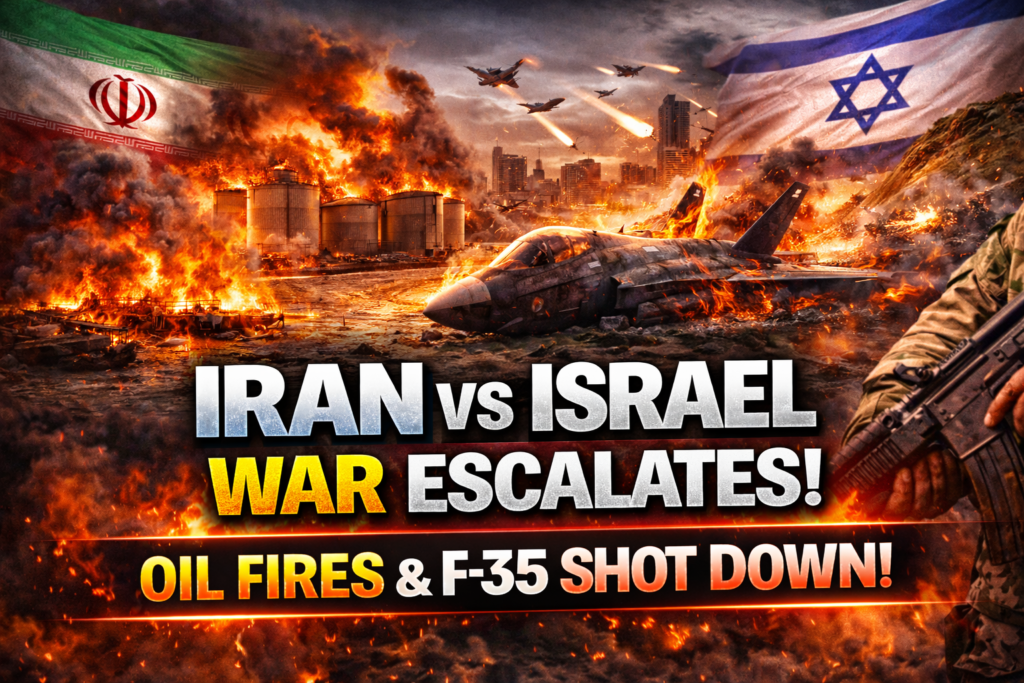
In the past few hours, reports have emerged claiming that Iran has set oil storage tanks ablaze in Fujairah, United Arab Emirates, and allegedly shot down an F-35 fighter jet. At the same time, analysts are debating whether the United States and Israel can realistically win a prolonged war without deploying ground forces. Behind the airstrikes, missile exchanges, and proxy maneuvering, a far more complex strategic game appears to be unfolding—one that may involve Kurdish factions, regional energy corridors, and calculated escalation.
In this exclusive deep-dive analysis, we will explore:
- The reported oil tank fires in Fujairah and their strategic implications
- Claims surrounding the downing of an F-35 fighter jet
- Why air superiority alone may not decide the war
- The historical trauma of U.S. ground interventions
- The Kurdish card and proxy warfare dynamics
- The risk of a broader regional conflict
- What this means for energy markets and global stability
Let’s break it down—calmly, strategically, and without emotional noise.
Breaking Reports: Oil Storage Fires in Fujairah
According to emerging claims, oil storage tanks in Fujairah, located in the United Arab Emirates, were set on fire following alleged Iranian targeting. Hours after the reported strike, fires were said to still be burning.
Why Fujairah Matters
Fujairah is not just another port. It is one of the most strategically important oil storage and bunkering hubs in the Gulf region. Its significance includes:
- Located outside the Strait of Hormuz, reducing chokepoint vulnerability
- Major oil storage capacity supporting Gulf exports
- Key node for global energy shipping routes
If such an attack were confirmed, the implications would be immediate:
- Energy price volatility
- Insurance costs for tankers skyrocketing
- Regional maritime security escalation
- Pressure on Gulf Cooperation Council states
Energy markets are highly sensitive to infrastructure attacks. Even limited damage can trigger psychological reactions in oil trading floors from London to Singapore.
The F-35 Claim: Strategic Shock or Information Warfare?
Another explosive claim suggests that Iran shot down an F-35 fighter jet, reportedly described as “the size of a football field” in symbolic exaggeration.
The F-35 is among the most advanced stealth aircraft in modern military aviation. If confirmed, such a downing would represent:
- A technological breakthrough for Iranian air defense systems
- A major symbolic blow to U.S. or Israeli deterrence credibility
- Potential intelligence windfall if wreckage were recovered
However, it is important to treat such claims cautiously. In modern conflicts, information warfare plays a critical role. Announcements about high-profile equipment losses can:
- Boost domestic morale
- Signal deterrence to adversaries
- Influence global public perception
Whether verified or not, the psychological dimension matters as much as the physical event.
Can the United States and Israel Win Without Ground Intervention?
Let’s address the strategic core of the debate.
Air power dominates headlines—precision strikes, missile barrages, drone swarms. But historically, wars are rarely won by air campaigns alone.
Air Superiority vs. Territorial Control
The United States and Israel possess overwhelming aerial dominance. Yet airstrikes achieve limited objectives:
- Degrading missile sites
- Disrupting command centers
- Destroying infrastructure
They do not:
- Permanently control territory
- Eliminate entrenched paramilitary networks
- Change internal political structures
To dismantle organizations like Iran’s Revolutionary Guard Corps inside Iran, ground forces would traditionally be required.
But that’s precisely where the dilemma begins.
America’s Ground War Trauma
There is a deep institutional memory in Washington regarding ground interventions.
Iraq
During the Iraq War, U.S. forces encountered intense insurgency warfare, particularly in cities like Fallujah. Urban combat created:
- Heavy casualties
- Long-term psychological trauma among veterans
- Strategic fatigue at home
The scale of post-war health services for veterans expanded dramatically in the years that followed.
Somalia
In Somalia, the Battle of Mogadishu remains a stark reminder of urban warfare risks. A limited mission escalated into a high-profile confrontation that reshaped U.S. foreign intervention doctrine.
Afghanistan
In Afghanistan, operations like Anaconda and the Battle of Kamdesh highlighted the challenges of mountainous insurgent warfare. Despite overwhelming military superiority, long-term stability proved elusive.
The Psychological Cost
In 2012, reported suicide rates among U.S. service members exceeded combat fatalities that year—a statistic that sparked serious debate about the hidden cost of prolonged conflict.
This legacy creates a powerful deterrent against large-scale ground deployments.
Israel’s Ground Challenges
Israel has unmatched aerial intelligence and rapid-strike capability. However, urban combat—such as past confrontations in Gaza neighborhoods—demonstrated how difficult dense ground operations can be.
Ground offensives bring:
- Civilian casualty risks
- International diplomatic pressure
- Logistical vulnerability
- Extended exposure to asymmetric tactics
No modern military treats ground war lightly—especially in terrain as complex as Iran’s mountainous interior.
The Kurdish Card: Proxy Warfare Strategy?
Here’s where the geopolitical chessboard becomes more intricate.
Following recent tensions, reports suggest increased engagement between Washington and certain Kurdish factions. Among the groups mentioned in regional discussions are:
- Komala Party
- Kurdistan Democratic Party of Iran
- Kurdistan Freedom Party
Why the Kurds?
Kurdish regions span parts of Iraq, Iran, Turkey, and Syria. Historically, Kurdish groups have sought greater autonomy.
A proxy ground force supported by air cover could theoretically:
- Avoid direct U.S. or Israeli troop deployment
- Apply internal pressure on Iranian security forces
- Open secondary fronts
However, this strategy carries major risks:
- Escalating regional ethnic tensions
- Provoking Turkey, which opposes expanded Kurdish militarization
- Triggering retaliation from Iranian-aligned militias
Proxy warfare may reduce direct exposure—but it does not eliminate escalation.
Why Iran Is Targeting Kurdish Regions
Observers have noted increased Iranian activity around Erbil and Kurdish areas. Erbil has periodically been targeted by missile or drone operations.
From Tehran’s perspective, this could represent:
- Preemptive deterrence
- Disruption of suspected coordination
- Strategic messaging
Iran understands the proxy dynamic well—it has used similar tactics across the region for decades.
Energy Warfare: Aramco and the Regional Domino Effect
Energy remains the silent battlefield.
Past attacks on Saudi Aramco demonstrated how vulnerable infrastructure can shift global oil prices overnight.
If Saudi Arabia were drawn directly into open confrontation, it could trigger:
- UAE alignment
- Qatari and Kuwaiti positioning
- Full Gulf regional escalation
This transforms the conflict from bilateral confrontation into a multi-state proxy war.
Air Power Is Powerful—But Not Absolute
Let’s imagine a scenario.
You’re commanding an advanced military force with total control of the skies. You strike missile depots daily. You intercept drones. You degrade radar networks.
But weeks later:
- Supply chains adapt
- Hidden launchers reappear
- Political leadership remains intact
- Public sentiment hardens
This is the paradox of air warfare. Tactical dominance does not always equal strategic victory.
The Information War Layer
Modern conflicts unfold simultaneously across:
- Battlefields
- Financial markets
- Social media
- Diplomatic corridors
Claims about F-35 downings or oil infrastructure attacks are not merely battlefield updates—they are strategic narratives.
Information can:
- Influence oil prices
- Pressure alliances
- Shape domestic morale
- Deter or provoke intervention
In this environment, perception becomes a weapon.
Could This Become a Regional War?
The alignment matrix is concerning:
- Iran
- Potential backing dynamics involving Russia and China
- U.S. and Israeli coordination
- Gulf states balancing security and economic risk
- Kurdish factions navigating survival
A localized conflict risks cascading into:
- Maritime disruptions
- Energy supply shocks
- Proxy militia mobilizations
- Cyber warfare escalation
The Middle East has experienced proxy wars before—but simultaneous multi-front escalation involving advanced air power raises new stakes.
The Human Cost Behind Strategy
It’s easy to discuss strategy in abstract terms. But behind every missile strike are:
- Families displaced
- Civilians under psychological stress
- Young soldiers facing trauma
- Economies destabilized
History shows us that wars rarely unfold as planners expect. Escalation paths are easier to enter than to exit.
If you step back and look at the bigger picture, you realize something: every side believes it is acting defensively or strategically necessary. Yet the cumulative result pushes the region closer to wider confrontation.
Conclusion: Air Dominance, Ground Fear, and Proxy Calculations
The alleged oil fires in Fujairah, claims of an F-35 downing, and speculation about Kurdish involvement all point toward a broader strategic crossroads.
The United States and Israel hold unmatched air capabilities. But history demonstrates the limits of air power without ground enforcement.
Ground intervention carries political, psychological, and strategic risk—especially for the United States, whose past experiences in Iraq, Somalia, and Afghanistan remain deeply influential.
Proxy warfare may appear as a middle path. Yet it introduces unpredictable regional consequences.
The question is no longer simply who can strike harder from the sky. The real question is:
Who can manage escalation without losing control of it?
Call to Action
What’s your perspective—can air power alone decide modern wars, or is ground presence inevitable? Share your thoughts in the comments and join the discussion.
If you found this analysis valuable, share it with others who follow Middle East geopolitics.
Iran–Israel war escalation analyzed: Fujairah oil fires, F-35 downing claims, U.S. ground war dilemma, Kurdish proxy strategy, and regional risks.