

Introduction
What would happen if the global oil supply suddenly stopped tomorrow?
How long could the world’s major economies continue operating using only their existing crude oil reserves?
This question has become increasingly important as geopolitical tensions rise across the Middle East, Eastern Europe, and Asia. Oil is not just another commodity—it is the backbone of modern civilization. Transportation, electricity generation, industrial manufacturing, aviation, and even agriculture rely heavily on oil and petroleum products.
Recent data about strategic petroleum reserves reveals a fascinating and somewhat alarming picture: different countries can survive vastly different lengths of time without importing new oil.
Some nations could operate for over 250 days, while others may face a crisis in less than a month.
In this article, we will explore:
- The global oil reserves by country
- How many days each major economy can survive
- Why energy security is now a central geopolitical issue
- What would happen if a major oil supply disruption occurs
- And what the future of global energy strategy might look like
Understanding these numbers helps explain why oil remains one of the most powerful strategic resources in the world.
Understanding Strategic Oil Reserves
Before analyzing the numbers, it is important to understand what strategic petroleum reserves (SPR) actually are.
Strategic reserves are emergency oil stockpiles that governments maintain to protect their economies against:
- War
- Supply disruptions
- Sanctions
- Natural disasters
- Global market shocks
These reserves allow countries to continue functioning even if global oil trade temporarily collapses.
Why Oil Reserves Matter
Oil reserves provide countries with three critical advantages:
- Economic stability
- Military readiness
- Energy independence
In a crisis, the countries with the largest reserves can continue operating while others may face fuel shortages, inflation, and economic collapse.
Global Oil Reserves: Days of Survival by Country
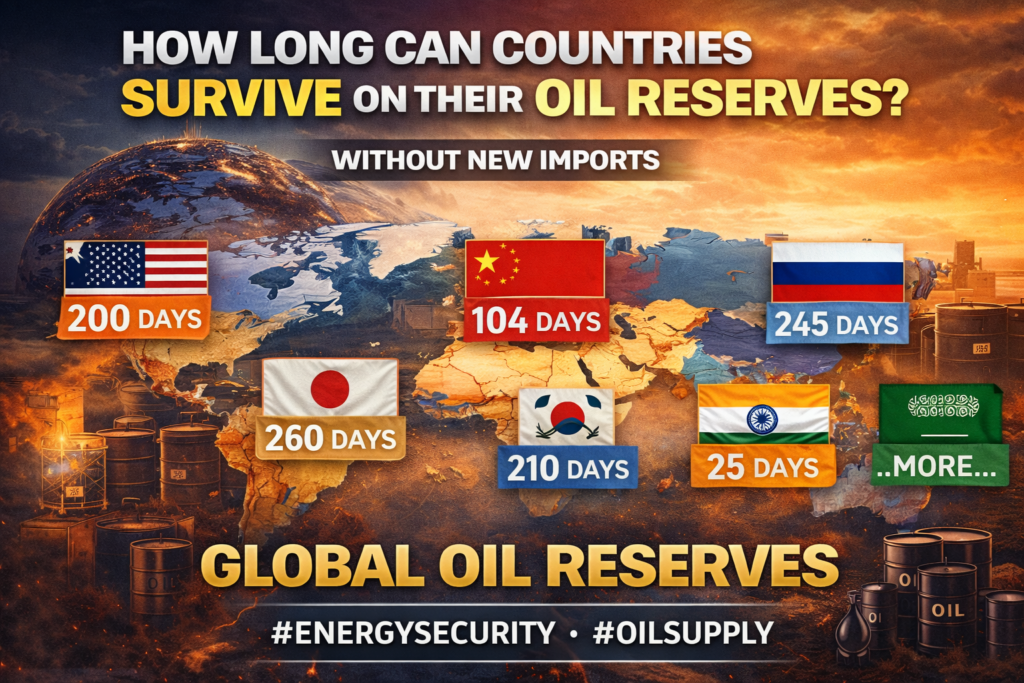
Recent estimates show how long major economies could continue operating using their existing oil stockpiles.
| Country | Estimated Days of Oil Supply |
|---|---|
| United States | 200 days |
| China | 104 days |
| Japan | 260 days |
| South Korea | 210 days |
| Russia | 245 days |
| India | 25 days |
These numbers reveal massive differences in energy preparedness.
Let’s break down what they mean.
United States: A Strategic Energy Superpower
The United States maintains one of the largest emergency oil reserves in the world.
Its Strategic Petroleum Reserve stores hundreds of millions of barrels of crude oil in underground salt caverns along the Gulf Coast.
Key Advantages
- Massive storage infrastructure
- Domestic oil production
- Advanced refining capacity
With approximately 200 days of reserves, the U.S. could survive a major oil supply disruption for more than half a year.
However, the U.S. economy is extremely energy intensive, meaning long-term disruptions could still create serious challenges.
China: Rising Power with Limited Oil Buffer
China is the world’s largest energy consumer, but its strategic reserves remain relatively modest compared to its demand.
With roughly 104 days of oil reserves, China would face significant pressure during a prolonged supply disruption.
Why This Matters
China imports large volumes of oil from:
- Middle Eastern countries
- Russia
- Africa
Any geopolitical crisis affecting these routes—especially through the Strait of Hormuz or South China Sea—could quickly impact China’s energy security.
That is why China has been aggressively expanding its reserves and investing heavily in:
- Renewable energy
- Electric vehicles
- Strategic oil storage facilities
Japan: The World’s Most Prepared Importer
Japan has almost no domestic oil production, yet it is among the best-prepared countries for an oil crisis.
With 260 days of reserves, Japan holds one of the largest emergency buffers globally.
How Japan Achieved This
After the 1970s oil crisis, Japan made energy security a national priority.
It invested heavily in:
- Strategic reserves
- Energy efficiency
- Diversified energy sources
Today, Japan’s oil storage strategy is considered one of the most advanced in the world.
South Korea: Strong Reserves for a Trade-Driven Economy
South Korea holds around 210 days of oil reserves, making it another highly prepared nation.
Given that South Korea is a global manufacturing powerhouse, maintaining stable energy supply is critical for industries like:
- Electronics
- Shipbuilding
- Automotive manufacturing
The country’s energy strategy focuses heavily on:
- Strategic reserves
- LNG imports
- Nuclear power
Russia: Energy Giant with Long-Term Security
Russia is not only a major oil exporter—it also holds large domestic reserves.
With approximately 245 days of oil supply, Russia enjoys significant energy security.
Unlike many other nations, Russia can rely on:
- Domestic oil production
- Extensive pipeline networks
- State-controlled energy infrastructure
This gives Russia a major geopolitical advantage during energy crises.
India: The Most Vulnerable Major Economy
India’s situation is dramatically different.
With only about 25 days of oil reserves, India is highly vulnerable to supply disruptions.
Why India’s Reserves Are Limited
Several factors contribute to India’s low reserves:
- Rapid economic growth
- Rising energy demand
- Limited storage infrastructure
- Heavy dependence on imports
India imports more than 80% of its oil, primarily from the Middle East.
Any disruption in global oil supply could create immediate economic pressure.
Why Oil Reserves Are Becoming More Important
The world is entering an era of increasing geopolitical instability.
Several factors are making energy security more critical than ever.
1. Rising Global Conflicts
Conflicts in oil-producing regions can disrupt supply chains quickly.
The Middle East remains particularly sensitive due to its massive oil reserves.
2. Trade Route Vulnerabilities
Much of the world’s oil travels through narrow maritime chokepoints such as:
- Strait of Hormuz
- Suez Canal
- Strait of Malacca
Any disruption in these routes could affect global supply.
3. Economic Competition
Major powers are increasingly competing for energy resources.
Countries are investing heavily in reserves to avoid dependence on foreign suppliers.
What Happens During an Oil Supply Shock?
When oil supply suddenly drops, several economic effects occur almost immediately.
Fuel Prices Skyrocket
Oil prices can rise dramatically, affecting gasoline, transportation, and manufacturing costs.
Inflation Increases
Higher energy costs push up the price of goods and services.
Economic Growth Slows
Industries dependent on energy face higher operating costs.
Governments Release Strategic Reserves
Countries may release oil from their strategic reserves to stabilize markets temporarily.
The Future of Global Energy Security
While oil remains critical today, many countries are trying to reduce dependence on fossil fuels.
Key Trends
- Renewable energy expansion
- Electric vehicle adoption
- Hydrogen fuel research
- Energy storage technology
However, experts agree that oil will continue to play a major role in the global economy for decades.
This means strategic oil reserves will remain essential for national security.
Conclusion
Oil is far more than a simple commodity—it is a pillar of modern civilization.
The data on global oil reserves shows that some nations are well prepared for energy disruptions, while others remain vulnerable.
Countries like Japan, Russia, and the United States have built large reserves that can sustain their economies for months.
Others, such as India, may face serious challenges if global supply chains are interrupted.
As geopolitical tensions and energy competition continue to rise, energy security will remain one of the defining issues of the 21st century.
Understanding how long each country can survive without new oil gives us valuable insight into global power dynamics—and the fragile balance that keeps the world economy running.
Call to Action
What do you think about these numbers?
Which country do you believe is best prepared for a global energy crisis?
Share your thoughts and join the discussion.
Global oil reserves explained: discover how many days major countries like the U.S., China, Japan, and India can survive without new crude oil supplies.
- Global oil reserves map showing strategic petroleum reserves by country
- Crude oil storage tanks representing global energy security
- Infographic of oil reserve days by country