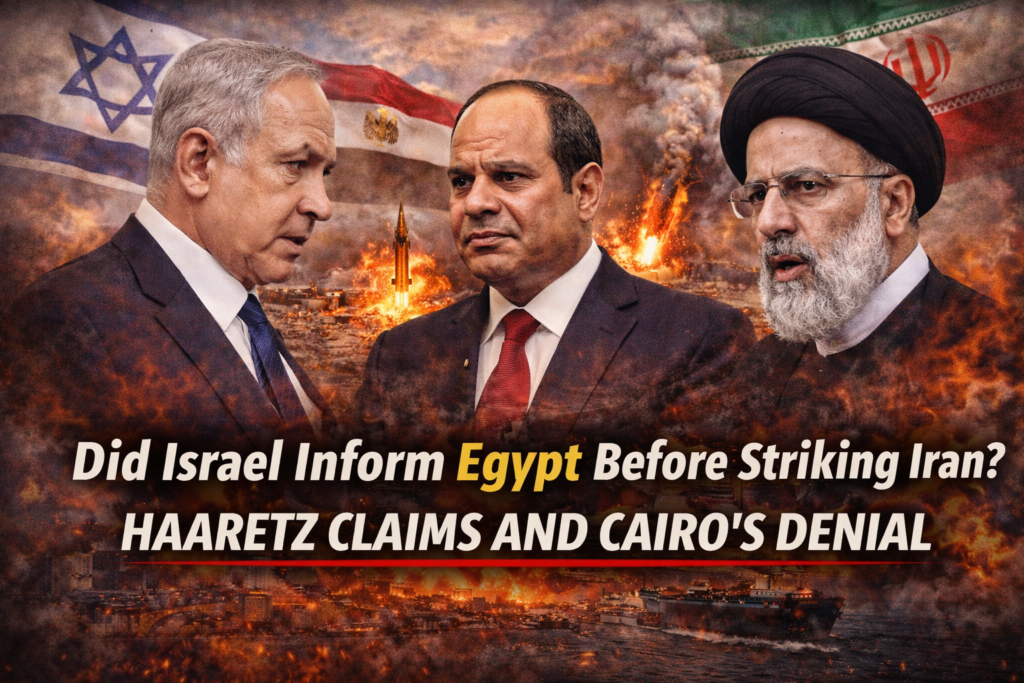

An in-depth geopolitical analysis of Haaretz claims that Israel informed Egypt before striking Iran, and Cairo’s official denial amid rising regional tension.
Introduction
Did Israel really inform Egypt 48 hours before launching a strike on Iran — or is this part of a larger information battle unfolding across the Middle East?
A report by the Israeli newspaper claimed that Tel Aviv notified Cairo in advance of military operations targeting Iran. The allegation quickly triggered political debate, especially after an official Egyptian source categorically denied the claim.
In a region already tense due to Iran–Israel confrontation and broader U.S. involvement, this narrative clash raises critical questions:
- Is this about operational coordination — or strategic messaging?
- Why would Israel publicize such a claim?
- Why did Egypt respond so rapidly and firmly?
- What does this mean for regional stability?
Let’s break this down carefully.
The Haaretz Claim: Strategic Disclosure or Media Leak?
According to Haaretz, Israel allegedly informed Egypt of the planned strike roughly 48 hours before execution, suggesting that several regional actors were aware of the operation in advance.
If true, such communication could serve multiple purposes:
- Avoiding accidental escalation
- Preventing airspace misunderstandings
- Signaling transparency to neighboring states
- Reducing the risk of miscalculation
However, the publication of this information — whether accurate or not — carries its own strategic implications.
In geopolitics, what gets reported is often as important as what actually happened.
Egypt’s Official Denial: Protecting Sovereignty and Regional Balance
An official Egyptian source firmly rejected the Israeli narrative, stating that Cairo had no prior knowledge of operational details related to the strike.
This denial serves several strategic objectives:
- Preserving National Sovereignty
Egypt maintains a long-standing doctrine of independent foreign policy decision-making. - Avoiding Perception of Alignment
Any suggestion of coordination could be interpreted as indirect involvement in anti-Iran operations. - Preventing Domestic Political Fallout
Public opinion in the region is highly sensitive to military actions involving Iran and Israel.
Cairo’s swift response indicates recognition that perception management is critical in times of heightened tension.
The Information War Dimension
This episode reveals something deeper: a parallel narrative battle.
Beyond missiles and airstrikes, there is a strategic contest over:
- Regional legitimacy
- Alliance framing
- Public perception
- Political positioning
By suggesting prior notification, Israel could be attempting to:
- Portray regional awareness or tacit acceptance
- Reduce diplomatic backlash
- Signal integration within a broader anti-Iran alignment
- Reinforce the perception of a coordinated front
At the same time, Egypt’s rejection blocks that narrative and reasserts neutrality.
The Broader Regional Context: Why Timing Matters
This controversy unfolds amid:
- Heightened Iran–Israel tension
- Expanded U.S. military posture in the region
- Increased global polarization
- Energy market sensitivity
Any suggestion of coordinated action among Arab capitals and Israel could:
- Escalate diplomatic friction with Tehran
- Fuel internal political criticism
- Deepen regional mistrust
In such an environment, even media reports can destabilize.
The Role of U.S. Alignment Narratives
Some observers link the narrative framing to broader attempts to present a unified regional bloc aligned with Washington — particularly during periods associated with assertive U.S. policy under figures such as .
Whether such portrayals reflect reality or strategic messaging, they serve to:
- Project cohesion
- Signal deterrence
- Influence global perception
But cohesion presented externally does not always mirror internal diplomatic positioning.
Why This Matters More Than It Seems
You might ask: Why does a single media report matter so much?
Because in geopolitics:
- Perception shapes alliances.
- Narratives influence markets.
- Public opinion affects leadership decisions.
- Trust between states is fragile.
If Egypt were perceived — even inaccurately — as having prior coordination, it could alter:
- Iran–Egypt diplomatic dynamics
- Public discourse within Arab societies
- Regional mediation credibility
That’s why rapid clarification was strategically necessary.
Scenario Analysis
Let’s consider three possible explanations:
Scenario 1: Misinterpretation or Exaggeration
The report may have overstated routine diplomatic communication.
Scenario 2: Controlled Strategic Leak
The claim may have been deliberately published to project regional alignment.
Scenario 3: Information Pressure Tactic
The narrative may aim to create political discomfort in Cairo and test its positioning.
At this stage, there is insufficient evidence to confirm operational coordination.
But the communication battle itself is real.
Strategic Takeaways
- The Haaretz claim and Egypt’s denial highlight narrative competition, not just military tension.
- Egypt’s response reinforces its policy of sovereign decision-making and regional balance.
- Israel’s framing could serve deterrence and alliance signaling purposes.
- Information warfare increasingly accompanies physical conflict.
- Regional stability depends as much on perception management as military restraint.
Conclusion
In today’s Middle East, wars are fought on multiple fronts:
- Military
- Diplomatic
- Economic
- Informational
The dispute between Haaretz’s report and Egypt’s denial is not just about whether a phone call happened 48 hours before a strike. It reflects a deeper struggle over alignment, sovereignty, and narrative dominance in a region on edge.
At a time of escalating global tension, clarity matters.
Strategic restraint matters.
Accurate information matters even more.
Call to Action
Do you see this as a media exaggeration — or part of a larger geopolitical messaging strategy? Share your perspective in the comments.
If this analysis helped clarify the bigger picture, share it with others following regional developments.