
Introduction: Is the Middle East Becoming the Center of a Global Power Clash?
What if the escalating tensions in the Middle East are not just another regional conflict — but the early stages of a much larger global confrontation?
In recent months, geopolitical developments surrounding Iran, Israel, and the United States have drawn the attention of analysts, military experts, and political observers across the world. However, beneath the visible surface of missile strikes, military warnings, and diplomatic accusations lies a far deeper strategic struggle.
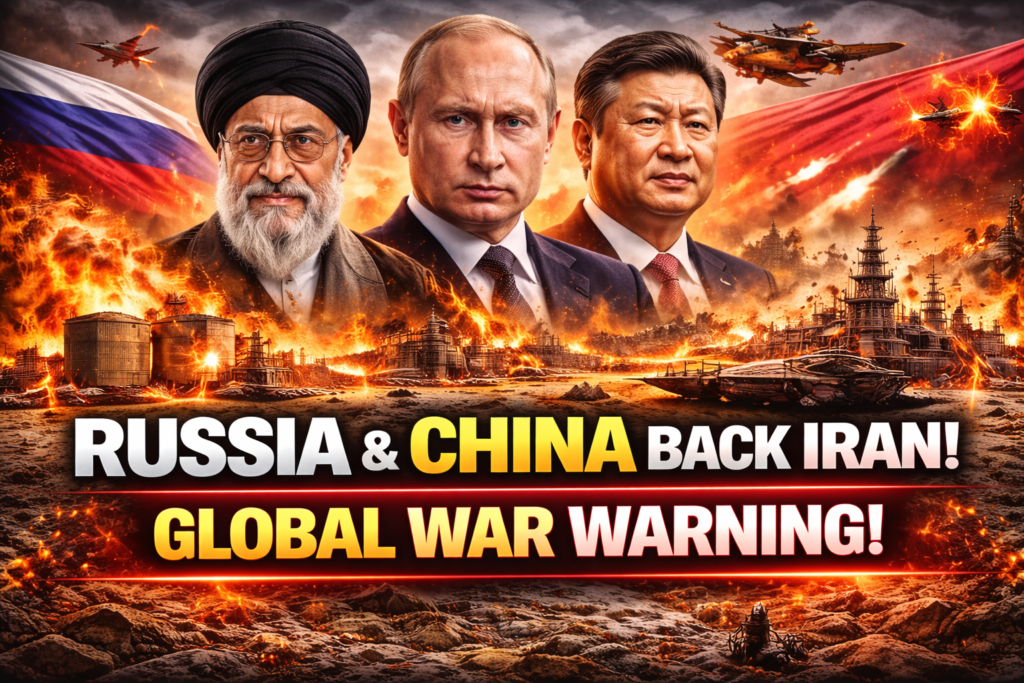
Russia and China — two of the most influential global powers — appear increasingly involved in the evolving dynamics of the region. Their growing alignment with Iran suggests that the conflict is no longer limited to local rivalries.
Instead, many experts believe the Middle East may now be the stage for a broader geopolitical contest between two emerging blocs:
- The United States and its Western allies
- Russia, China, and their strategic partners
In this comprehensive analysis, we will explore:
- Why Russia may be supporting Iran in the current conflict
- How military and technological cooperation is shaping the battlefield
- China’s massive economic interests in Iran
- How global sanctions are being challenged by a parallel economic system
- Whether the ultimate objective of the conflict could be regime change in Tehran
- And what this evolving confrontation could mean for global stability
Understanding these dynamics is crucial, because the outcome of this struggle may influence global power structures for decades.
Russia’s Strategic Response: Settling the Score With Washington
Ukraine and the Global Power Equation
Since the beginning of the war in Ukraine, relations between Russia and the United States have reached one of their lowest points since the Cold War.
From Moscow’s perspective, Western support for Ukraine — including military aid, intelligence sharing, and economic sanctions — represents a direct challenge to Russian power.
Many geopolitical analysts argue that Russia now views conflicts involving American interests as opportunities to counterbalance Western influence.
In this context, the Middle East presents a strategic opportunity.
Iran, long considered a geopolitical rival of the United States, naturally becomes a partner in this broader competition.
A Strategic Message From Moscow
Russian leadership, including President Vladimir Putin, has repeatedly emphasized the importance of creating a “multipolar world” — a global order where power is distributed among several major players rather than dominated by a single superpower.
Supporting Iran, even indirectly, can serve several purposes for Moscow:
- Distracting U.S. military focus away from Eastern Europe
- Strengthening alliances outside the Western sphere
- Demonstrating Russia’s continued geopolitical influence
In simple terms, if Washington challenges Moscow in Ukraine, Russia may be willing to challenge American influence elsewhere.
Hidden Military Support: Logistics, Technology, and Strategic Cooperation
While official statements often remain cautious, reports suggest that military cooperation between Russia and Iran has expanded significantly in recent years.
Commercial Ships With Strategic Cargo
According to multiple geopolitical analysts, Russia has allegedly used commercial shipping routes across the Caspian Sea to transport military equipment to Iran.
Using civilian vessels allows such transfers to remain less visible than traditional military deployments.
These shipments may include:
- Advanced radar systems
- Electronic warfare equipment
- Air defense components
- Communication and surveillance technology
The Caspian Sea provides a particularly useful route because it is geographically enclosed by countries that are either neutral or friendly toward Russia and Iran.
Electronic Warfare: A New Battlefield
One of the most significant technological areas of cooperation involves electronic warfare.
Electronic warfare systems can:
- Jam radar signals
- Disrupt aircraft navigation systems
- Interfere with satellite communications
- Blind enemy detection systems
If Iran has indeed received advanced electronic warfare technology, it could potentially complicate aerial operations conducted by both the United States and Israel.
This type of warfare often happens silently, without explosions or headlines, but its strategic impact can be enormous.
China’s Strategic Interests: Economics, Energy, and the Belt and Road Initiative
While Russia’s involvement may be driven largely by geopolitical rivalry with the West, China’s motivations are primarily economic.
China’s global strategy relies heavily on long-term infrastructure and trade networks designed to strengthen its economic influence.
One of the most important of these projects is the Belt and Road Initiative.
Iran’s Critical Role in the Belt and Road
China views Iran as a central corridor linking Asia, the Middle East, and Europe.
Through railway networks, pipelines, and transportation routes, Iran provides a key connection point within the broader Belt and Road infrastructure plan.
If Iran were to experience major political instability or regime change aligned with Western interests, Chinese investments could face serious risk.
This explains why Beijing maintains strong diplomatic and economic ties with Tehran.
Energy Security and Iranian Oil
China is one of the world’s largest energy consumers, and Iranian oil plays a strategic role in helping meet this demand.
Despite international sanctions, trade relationships between the two countries have continued in various forms.
Energy security is a top priority for Beijing, and maintaining stable supply routes is essential to sustaining China’s economic growth.
Therefore, from China’s perspective, preserving stability in Iran is not just a diplomatic matter — it is an economic necessity.
A Parallel Economic System: Bypassing Western Sanctions
Another key aspect of the evolving partnership between Russia, China, and Iran is their cooperation in circumventing Western financial restrictions.
For decades, the global financial system has been dominated by the U.S. dollar and Western-controlled institutions.
Sanctions imposed by the United States often rely on this financial infrastructure to limit economic activity.
However, several countries are now exploring alternative systems.
How Sanctions Are Being Challenged
Russia and Iran have developed mechanisms that allow them to trade goods and resources without relying on traditional Western banking networks.
Examples include:
- Barter-based trade agreements
- Local currency transactions
- Alternative payment networks
- Non-dollar energy contracts
For instance:
- Iran may import Russian agricultural products such as wheat
- Russia may receive energy or industrial cooperation in return
These arrangements help both countries reduce their vulnerability to sanctions.
The Strategic Objective: Is Regime Change the Real Goal?
Many analysts believe the current tensions may extend beyond military deterrence.
Instead, they argue that a deeper objective could be influencing political change within Iran.
Understanding Regime Change Strategies
Historically, regime change strategies involve a combination of:
- Economic pressure
- Political isolation
- Military threats
- Support for internal opposition movements
The ultimate goal is to encourage a shift in leadership that aligns more closely with Western geopolitical interests.
Why Russia and China Are Concerned
From the perspective of Moscow and Beijing, the collapse or transformation of the Iranian government could significantly alter the balance of power in the Middle East.
Such an outcome might:
- Expand U.S. influence in the region
- Threaten Chinese economic investments
- Reduce Russia’s strategic partnerships
This explains why both countries appear increasingly attentive to developments involving Iran.
The Risk of a Larger Global Confrontation
The most concerning aspect of the current situation is the possibility that regional conflicts could trigger broader global tensions.
History shows that large-scale conflicts often emerge gradually through a series of smaller confrontations.
The current geopolitical environment includes several overlapping rivalries:
- United States vs Russia
- United States vs China
- Iran vs Israel
- NATO vs emerging alliances
When these tensions intersect within a single region, the potential for escalation increases.
However, it is also important to recognize that major powers generally attempt to avoid direct military confrontation.
Instead, they often compete through:
- Proxy conflicts
- Economic pressure
- Technological competition
- Strategic alliances
Human Perspective: What This Means for Ordinary People
When discussing geopolitics, it is easy to focus only on strategy, power, and military capabilities.
But behind every conflict are millions of ordinary people whose lives are affected by these decisions.
Economic instability, rising energy prices, and regional insecurity impact families, businesses, and communities far beyond the battlefield.
If tensions continue to escalate, global markets, supply chains, and political stability could all be influenced.
This is why understanding geopolitical dynamics is important not only for policymakers but for everyone.
Conclusion: A Conflict Larger Than It Appears
The evolving tensions surrounding Iran are no longer simply a regional dispute.
Instead, they reflect a broader competition between emerging global power blocs.
Russia’s strategic calculations, China’s economic interests, and Western geopolitical objectives are now intersecting in one of the world’s most sensitive regions.
Whether this confrontation escalates further or gradually de-escalates will depend on diplomatic decisions made by multiple global actors.
For now, one thing remains clear:
The Middle East has once again become one of the central arenas shaping the future of international politics.
Call to Action
What do you think about the current geopolitical tensions?
Do you believe the conflict could expand into a larger global confrontation, or will diplomacy eventually prevail?
Share your thoughts in the comments and join the discussion.
Geopolitical analysis of the Iran–Israel conflict and the growing involvement of Russia and China. Explore military strategy, economic interests, and global power shifts.