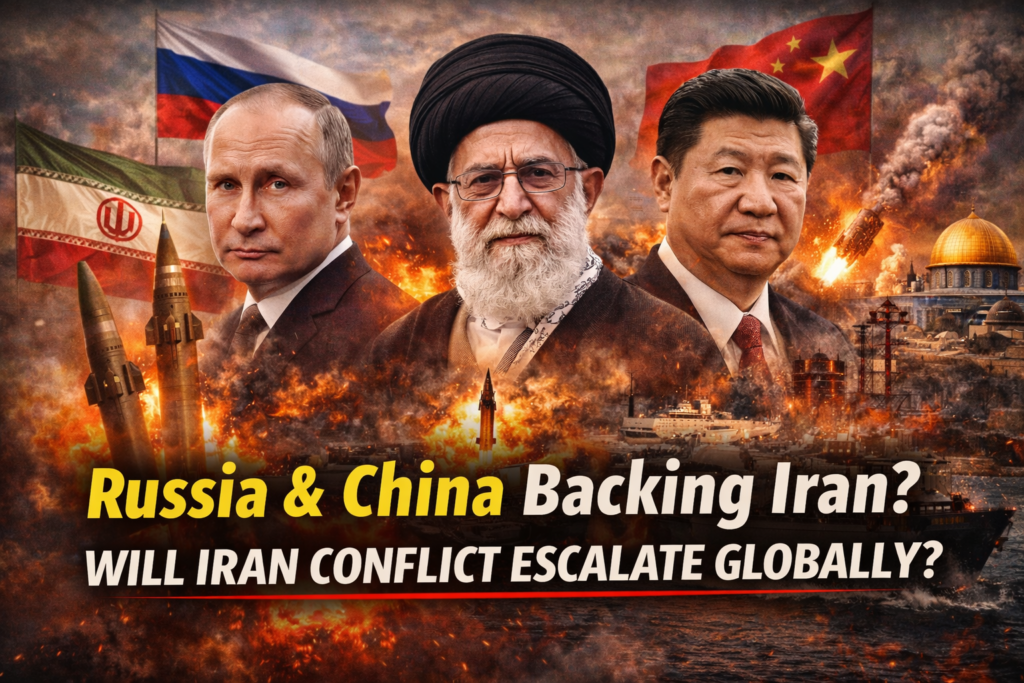

In-depth geopolitical analysis of potential Russian and Chinese support for Iran against the US and Israel amid rising Middle East tensions.
Introduction
What happens when regional tension turns into a global chess match?
As confrontation between Iran, the United States, and Israel intensifies, new geopolitical analyses suggest that Russia and China may not remain spectators. Instead, they could play calculated roles—directly or indirectly—reshaping the balance of power in the Middle East.
Are Moscow and Beijing preparing to back Tehran?
Is this about ideology—or strategic revenge and economic survival?
In this comprehensive geopolitical breakdown, we’ll explore:
- The scope of potential Russian support for Iran
- The strategic motivations of
- China’s economic calculus and the Belt and Road factor
- Sanctions evasion and shared economic interests
- Why leaders like and would view this alignment as alarming
- Why this conflict may be structurally more complex than previous regional wars
Let’s dissect this with strategic clarity.
The Russian–Iranian Axis: Quiet Military Coordination?
Indirect Military Support: What Could It Look Like?
Reports and analyses suggest that Russian involvement—if occurring—would likely be indirect:
- Military equipment transported via commercial shipping
- Intelligence-sharing channels
- Cyber coordination
- Air defense consultation
Direct troop deployment is unlikely. Moscow has learned from Ukraine that overt engagement invites unified Western backlash.
Instead, the model would resemble asymmetric enablement—support that strengthens Iran’s capacity without visibly placing Russian boots on the ground.
Vladimir Putin’s Strategic Motive: Retaliation Through Balance
Is This About Iran—or About the United States?
From a strategic lens, Putin’s interest in Iran is less emotional and more transactional.
After years of Western sanctions and NATO support for Ukraine, Moscow has incentive to:
- Stretch U.S. military bandwidth
- Increase Washington’s global commitments
- Raise the economic cost of containment
Supporting Iran indirectly creates:
- Strategic distraction
- Pressure on U.S. Middle East deployments
- Energy market instability that benefits Russian oil exports
It’s not about “love for Tehran.”
It’s about recalibrating leverage.
You could call it geopolitical counter-punching.
China’s Role: Stability Over Escalation
Unlike Russia, China’s approach is economically anchored.
Why Iran Matters to Beijing
Iran plays a key role in:
- The Belt and Road Initiative (BRI)
- Energy supply diversification
- Overland trade corridors bypassing maritime chokepoints
China has:
- Signed long-term infrastructure deals with Iran
- Invested in ports and transport corridors
- Purchased discounted Iranian oil
For Beijing, the priority is stability, not open war.
China’s likely posture:
- Diplomatic balancing
- Quiet economic backing
- Avoiding overt military involvement
Escalation threatens trade routes. Trade routes power China’s economy.
Sanctions Evasion: The Economic Triangle
One underreported dimension is the energy triangle between Russia, Iran, and China.
How It Works
- Russia exports sanctioned oil at discounted rates.
- Iran imports and blends or re-exports under alternative channels.
- China purchases under non-dollar settlements.
This arrangement:
- Weakens Western sanctions
- Preserves revenue streams
- Deepens financial interdependence
Energy geopolitics is often invisible—but decisive.
Why Washington and Tel Aviv Would Be Concerned
If Russia increases indirect military backing and China reinforces economic shielding, the strategic environment shifts.
For the United States:
- Expanded deterrence requirements
- Higher operational costs
- Greater regional uncertainty
For Israel:
- Elevated missile risk
- Expanded intelligence pressure
- Reduced diplomatic maneuver space
Leaders like Donald Trump and Benjamin Netanyahu—known for assertive security postures—would interpret such alignment as a strategic escalation, not mere symbolism.
Is This Conflict Structurally Different?
Many analysts compare current tensions to previous short-duration flare-ups.
But this time, the objective may be different.
Previous Conflicts:
- Targeted strikes
- Limited retaliation
- Status quo preservation
Current Risk:
- Regime destabilization
- Systemic power realignment
- Great-power indirect confrontation
When regime change enters the equation, escalation risk multiplies.
This is no longer just missile arithmetic.
It becomes political survival.
Scenario Modeling: What Comes Next?
Scenario 1: Controlled Proxy Tension
- Limited Russian logistical support
- Chinese economic buffering
- No direct superpower clash
Probability: Moderate to High
Scenario 2: Economic Warfare Intensifies
- Expanded sanctions
- Energy price volatility
- Financial decoupling accelerates
Probability: High
Scenario 3: Multi-Front Strategic Confrontation
- Coordinated Iranian retaliation
- Israeli preemptive operations
- Russian intelligence integration
Probability: Lower—but high impact.
The Human and Regional Dimension
While global powers maneuver, regional populations absorb the shock:
- Oil price spikes increase living costs
- Currency volatility affects savings
- Travel restrictions disrupt families
For countries like Egypt and broader Arab states, stability is paramount.
Geopolitical tremors do not respect borders.
Strategic Takeaways
- Russia’s potential support for Iran is likely indirect and strategic.
- Putin’s motivation centers on leverage against the United States.
- China prioritizes economic continuity over military escalation.
- Sanctions evasion creates shared incentives between Moscow and Tehran.
- This conflict carries higher structural complexity than previous short-term flare-ups.
Understanding the motivations behind state behavior prevents emotional misinterpretation.
Conclusion
The possibility of Russian and Chinese backing for Iran does not automatically signal world war—but it does signal strategic recalibration.
We are witnessing layered power competition:
- Military signaling
- Energy realignment
- Economic hedging
- Diplomatic positioning
The Middle East is not just a battlefield—it is a convergence point for global rivalry.
Prudence, diplomacy, and strategic restraint will determine whether tension stabilizes—or transforms into a broader confrontation.
May stability prevail across Egypt, the Arab region, and the wider world during these uncertain times.
Call to Action
Do you believe Russia and China will escalate their involvement—or remain calculated observers? Share your analysis in the comments.
If this breakdown clarified the geopolitical picture, share it with others who follow global strategy.