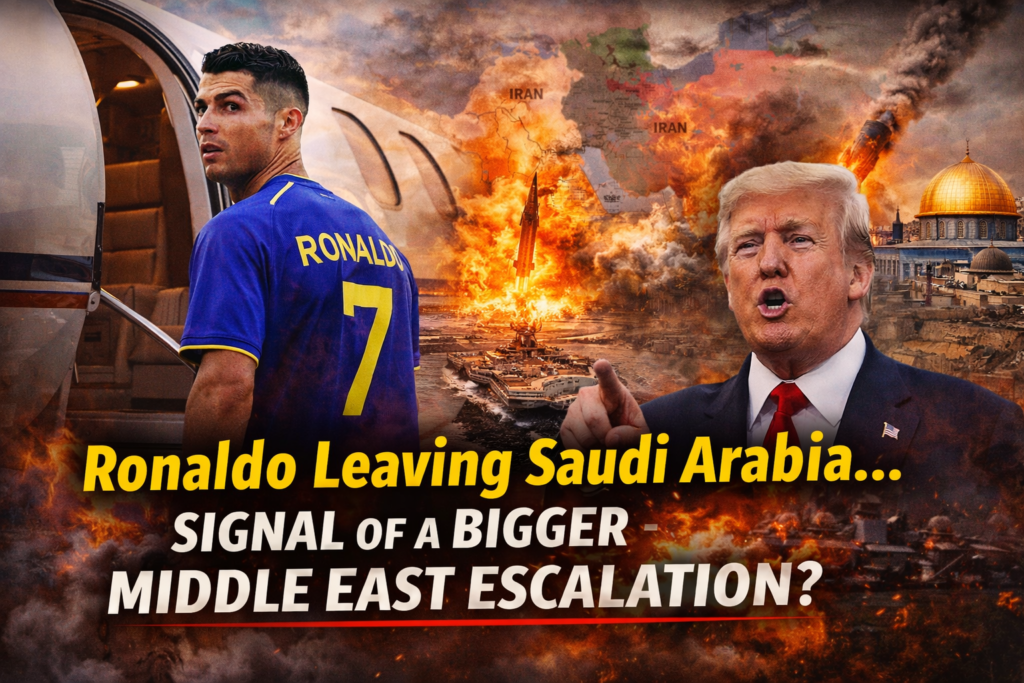

Cristiano Ronaldo leaves Riyadh during Gulf airport closures. Is this linked to Middle East escalation, US evacuation orders, and Iran tensions?
Introduction
What if a football transfer wasn’t just about football?
Amid rising tension in the Gulf, temporary airspace disruptions, and reports of U.S. evacuation advisories, news that departed Riyadh on a private flight has triggered intense speculation online. Add to that long-standing admiration expressed by , and suddenly social media narratives are connecting dots that may—or may not—be connected.
So what’s really happening?
In this in-depth geopolitical analysis, we’ll examine:
- The context behind Gulf airport restrictions
- Whether Ronaldo’s departure signals strategic risk
- The broader Middle East escalation involving Iran, the U.S., and Israel
- How evacuation advisories typically work
- Why viral narratives spread faster than verified intelligence
Let’s separate emotional reaction from strategic reality.
The Context: Gulf Airspace Disruptions and Security Measures
Periods of regional tension often lead to:
- Temporary airspace restrictions
- Heightened airport security
- Adjusted civilian flight paths
- Military coordination over strategic zones
These measures are precautionary. Aviation authorities frequently close or reroute airspace due to:
- Military exercises
- Missile testing
- Intelligence-based risk assessments
- Political escalations
It is critical to understand: airport closures do not automatically signal imminent war.
Cristiano Ronaldo’s Departure from Riyadh: What We Actually Know
Cristiano Ronaldo currently plays for in Saudi Arabia. As a global athlete with:
- Significant commercial commitments
- International travel obligations
- Personal security arrangements
Private jet movement is routine for someone of his profile.
High-profile athletes frequently relocate temporarily during:
- Off-season breaks
- Family travel
- Sponsorship appearances
- Security advisories
Without verified intelligence linking his departure to classified risk briefings, it remains speculative to interpret it as a geopolitical signal.
Donald Trump’s Admiration and U.S. Evacuation Orders
It is publicly known that Donald Trump has expressed admiration for Cristiano Ronaldo as an athlete. However, admiration does not equate to coordinated security messaging.
More importantly, U.S. evacuation advisories are not rare events. The U.S. government regularly issues:
- Travel warnings
- Non-essential staff withdrawals
- Voluntary departure notices
- Full evacuation orders (in extreme cases)
These advisories are based on:
- Intelligence assessments
- Threat modeling
- Regional force posture
- Diplomatic risk calculations
They are not triggered by the travel plans of individual athletes.
Middle East Escalation: Iran, the U.S., and Israel
The broader concern centers on Middle East escalation, particularly involving:
- Iran’s regional posture
- U.S. military presence
- Israel’s deterrence doctrine
Key Risk Factors
- Proxy Conflicts: Indirect engagements through allied groups.
- Energy Infrastructure Threats: Gulf oil routes remain globally critical.
- Missile and Drone Capabilities: Rapid response systems shorten reaction time.
- Cyber Warfare: Increasingly used alongside kinetic deterrence.
But here’s what matters: escalation develops through state-level strategic decisions, not celebrity travel patterns.
Why Viral Narratives Spread So Quickly
Let’s be honest—when you hear:
- Gulf airports closing
- U.S. evacuations announced
- Ronaldo leaves Saudi Arabia
- Tensions involving Iran and Israel
Your brain naturally connects them.
This is called pattern-seeking bias.
In high-anxiety environments, the human mind looks for signals. A famous athlete leaving becomes symbolic—even if unrelated.
Social media accelerates this by:
- Amplifying speculation
- Rewarding dramatic interpretation
- Compressing complex geopolitics into emotional headlines
Scenario Analysis: Is Something Bigger Imminent?
Let’s evaluate realistically.
Scenario 1: Elevated Tension, No Immediate War
- Airspace adjustments remain temporary
- Diplomatic backchannels operate quietly
- Energy markets stabilize
Probability: High
Scenario 2: Limited Military Exchange
- Targeted strikes
- Controlled retaliation
- No full regional war
Probability: Moderate
Scenario 3: Large-Scale Regional Conflict
- Multi-front engagement
- Oil shock
- Major power involvement
Probability: Lower—but impactful if triggered.
None of these scenarios depend on Cristiano Ronaldo’s travel schedule.
The Psychological Dimension of Fear
Imagine you’re living in the Gulf:
- Flights are delayed
- News channels show missile graphics
- Social feeds claim celebrities are “escaping”
Fear compounds quickly.
But strategic analysis requires:
- Verified data
- Intelligence confirmation
- Government briefings
- Observable military mobilization
Without those indicators, we remain in the realm of elevated tension—not confirmed war preparation.
What You Should Watch Instead
If you want real signals of escalation, monitor:
- Large-scale troop mobilization
- Naval deployment shifts
- Satellite-confirmed missile fueling
- Embassy staff drawdowns beyond non-essential levels
- Oil infrastructure targeting
These are measurable indicators.
Celebrity movement is not.
Strategic Takeaways
- Cristiano Ronaldo leaving Riyadh is not, by itself, evidence of impending war.
- U.S. evacuation advisories are procedural tools used in many regions.
- Middle East escalation risks are real—but driven by state actors, not athletes.
- Social media narratives often exaggerate correlations without causation.
- Emotional reactions are understandable—but analysis must remain grounded.
Conclusion
In volatile geopolitical climates, every high-profile event can feel like a coded message.
But responsible analysis requires discipline.
Yes, tensions involving Iran, the United States, and Israel deserve serious attention. Yes, Gulf airspace adjustments signal heightened caution. But linking Cristiano Ronaldo’s travel decisions to imminent regional war stretches beyond available evidence.
Stay informed—but stay analytical.
Fear spreads faster than facts. Your advantage is critical thinking.
Call to Action
What’s your perspective—coincidence or calculated timing? Share your thoughts in the comments below.
If this analysis helped clarify the situation, share it with others who want facts over speculation.