
Introduction: When Ambition Meets Reality
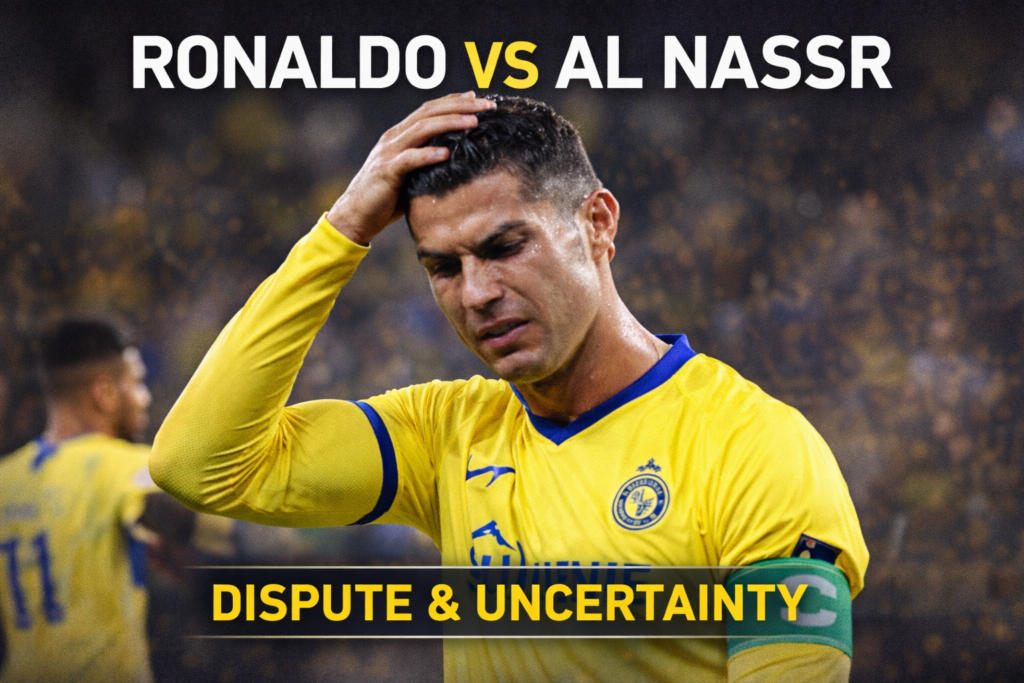
Cristiano Ronaldo’s move to Al Nassr was never just a football transfer. It was a global statement—one that reshaped perceptions of Saudi football and brought unprecedented attention to the Saudi Pro League. However, as the initial excitement faded, questions began to emerge. Recent weeks have seen growing discussion around Ronaldo’s relationship with Al Nassr, raising speculation about tension, unmet expectations, and uncertainty surrounding the future.
While no official crisis has been declared, the signs of friction are difficult to ignore.
High Expectations from Day One
From the moment Ronaldo arrived in Riyadh, expectations skyrocketed. Al Nassr were not only expected to compete—they were expected to dominate. Titles, continental success, and global recognition became immediate objectives.
For Ronaldo, the move represented more than financial security. At this stage of his career, legacy matters. He did not arrive to simply participate; he arrived to win, to lead, and to build a project capable of delivering silverware consistently.
When results failed to fully match those ambitions, frustration naturally followed.
Performance vs. Results: A Growing Disconnect
Statistically, Ronaldo has continued to deliver. Goals, assists, and decisive moments remain part of his game. However, football is judged by trophies, not numbers.
Al Nassr’s struggles in key competitions—whether domestic league inconsistency or continental disappointment—have fueled the perception that the team has not evolved quickly enough around their star player. For a competitor like Ronaldo, repeated setbacks create emotional and professional strain.
This disconnect between individual output and collective success is often at the heart of elite-level conflicts.
Leadership Tension Inside the Squad
Ronaldo’s leadership style has always been demanding. Throughout his career, he has pushed teammates relentlessly, setting standards that few can match. While this mentality drives excellence, it can also create friction—especially in squads still adapting to elite European-level professionalism.
Reports of visible frustration on the pitch, animated reactions, and moments of tension have been widely circulated. These are not signs of indifference, but of a player unwilling to accept mediocrity.
For Al Nassr, the challenge lies in balancing respect for Ronaldo’s authority with the need for collective harmony.
Tactical and Structural Challenges
Another layer of the issue lies in tactical identity. Ronaldo thrives in structured systems that maximize his strengths: controlled buildup, intelligent wide service, and midfield stability.
Al Nassr have, at times, struggled to provide consistent structure. Coaching changes, tactical experimentation, and squad imbalance have contributed to periods of instability. For a player accustomed to tactical clarity, this inconsistency can be deeply frustrating.
Footballing issues often manifest emotionally, and Ronaldo’s reactions may reflect deeper structural concerns rather than personal conflict.
Media Pressure and Global Spotlight
Unlike most players in the Saudi Pro League, Ronaldo operates under constant global scrutiny. Every gesture, substitution, or comment becomes headline material.
Local challenges that might remain internal at other clubs are magnified when Ronaldo is involved. This media pressure places additional strain on the relationship between player, club, and supporters.
In many ways, Al Nassr are still learning how to manage a global icon within a developing football ecosystem.
The Club’s Perspective
From Al Nassr’s standpoint, Ronaldo remains a transformational figure. His presence has elevated the club’s commercial value, global visibility, and league profile beyond expectation.
However, building a competitive project requires time, patience, and long-term planning. Rapid success is not always realistic, especially in leagues undergoing structural evolution.
The club faces a delicate task: satisfying Ronaldo’s competitive hunger while maintaining stability and strategic growth.
What Comes Next for Ronaldo and Al Nassr?
Several scenarios remain possible:
- Renewed commitment: Reinforced squad, clearer tactical vision, and renewed trust.
- Strategic compromise: Ronaldo adapts expectations while the club gradually strengthens.
- Eventual separation: If ambitions continue to diverge, a mutual decision to part ways could emerge.
At this stage, nothing is inevitable—but the direction taken in the coming months will define the legacy of this partnership.
Conclusion: A Defining Chapter Still Unwritten
Cristiano Ronaldo’s situation at Al Nassr is not simply about dissatisfaction or conflict. It reflects the collision between elite ambition and an evolving football project.
Whether this chapter becomes a story of triumph or transition depends on communication, clarity, and shared vision. What remains certain is that Ronaldo’s presence has already changed Al Nassr—and Saudi football—forever.
The next decision, however, may determine how this story is ultimately remembered.